
The rupee breached 90-levels against the greenback for the first time on Wednesday, falling 6 paise to 90.02 in early trade, as banks kept buying US dollars at higher levels and FII outflows continued.

The short-term inflation outlook for India is benign, and the expectation of a normal monsoon and moderating global prices of key imported items give credence to the projections made by the RBI and IMF, the Economic Survey said on Monday. However, to ensure long-term policy stability, the Survey 2023-24 suggested making focused efforts to increase the production of major oilseeds, expanding the area under pulses, and assess the progress in developing modern storage facilities for specific crops.

'I will not be surprised if there is a 7 per cent handle in front of the decimal place for the full financial year.'
'... and without necessarily calling them Economic Surveys.' 'One should stick to the main focus, which is to give people a good perspective on how the economy is doing.'

Chief Economic Advisor V Anantha Nageswaran on Thursday said the economy is expected to grow at 6.5 per cent in the current fiscal notwithstanding deficient rains in August. India recorded economic growth of 7.8 per cent in the April-June quarter of 2023-24 against 13.1 per cent in the year-ago period. India's economy in Q1 grew at the fastest pace in a year, on the shoulders of a boost in capital expenditure both at central and state levels, along with stronger consumption demand, especially in rural areas, and improved performance in the services sector, he said.

The outlook for India's financial sector appears bright, but it needs to brace for likely vulnerabilities, said Economic Survey 2023-24 tabled in Parliament on Monday. The Indian financial sector is at a "turnpike moment", it said, adding that the dominance of banking support to credit is being reduced, and the role of capital markets is rising. For a country that aspires to be a developed nation by 2047, this is a long-awaited and welcome development, it said.

Ahead of the upcoming budget, eminent economists during a meeting with Prime Minister Narendra Modi on Thursday urged the government to take steps to accelerate economic growth and improve infrastructure, sources said. The meeting was organised by the NITI Aayog on Thursday to elicit views and suggestions of economists for the first budget of the Modi 3.0 government. "Earlier today, interacted with eminent economists and heard their insightful views on issues pertaining to furthering growth," Modi said in a post on X.

The finance minister continues to be backed by the same policy team in charting out the broad strategy as in the few earlier Budgets.

The CII Business Summit 2025's inaugural session witnessed a rousing standing ovation and a felicitation ceremony for the defence top brass sending a strong message about India's rising military industrial complex and hghlghting that security is a top-of-the-mind issue for India Inc.

India's demographic advantage and diverse economic landscape position it uniquely to benefit from AI, the Economic Survey for 2024-25 tabled in the Parliament on Friday afternoon asserted. However, achieving these benefits requires significant investments in education and workforce skilling, supported by enabling, insuring, and stewarding institutions, the state of the economy report tabled by Finance Minister Nirmala Sitharaman said.

Chief Economic Advisor (CEA) V Anantha Nageswaran considers absolute poverty a more direct and pressing concern for India. He argues that inequality is a relative concept. Simultaneously, with formerly economically deprived sections joining the ranks of the middle class, policy attention needs to extend beyond 'roti, kapda, makaan' to keep the growth engine up and running.

Chief economic advisor V Anantha Nageswaran on Tuesday said Indian economy will grow at over 7 per cent, down from above 8 per cent of growth rate projected in January. He, however, said that the economic momentum and the animal spirits are "unmistakable". "India's own growth rates have come off the projections made in January down to about 7-plus per cent for the current financial year," Nageswaran said speaking at Global Fintech Fest event in Mumbai.

This will be the first full-year Budget of the BJP-led National Democratic Alliance government since it came to power for a third consecutive term in July last year.
Chief Economic Advisor V Anantha Nageswaran on Thursday expressed hope that the economy will maintain the trend growth rate of 6.5 per cent and above for the rest of the years in the current decade. The economy will close the current fiscal logging in a growth of 6.5-7 per cent, he said, citing the projections of private sector analysts, Reserve Bank of India (RBI) and international agencies like OECD and the IMF. "This appears to be reasonable at this point in time although we will get the data on the fiscal second quarter in a few days, which will give more clarity on these numbers.

The government on Wednesday reconstituted the Economic Advisory Council to the Prime Minister (EAC-PM) under existing chairman Bibek Debroy, for a period of two years. V Anantha Nageswaran has been dropped, Rakesh Mohan (former deputy governor of RBI), Poonam Gupta (director general of NCAER) and TT Ram Mohan (professor, IIM Ahmedabad) have been appointed as part-time members of the reconstituted EAC-PM. The other part-time members of the Council include Sajid Chenoy, Neelkanth Mishra and Nilesh Shah.

National Stock Exchange (NSE) chief Ashishkumar Chauhan on Friday cautioned retail investors against trading in derivatives and suggested them to invest in equities through mutual fund route. He emphasized that trading in Futures & Options (F&O) derivatives should be limited to informed investors who can manage risk and comprehend the market. Recently, Finance Minister Nirmala Sitharaman and chief economic advisor V Anantha Nageswaran flagged the growing risk of F&O trading for retail investors.
The banking sector in the country is stable, capital is available and credit offtake is poised to take off, he said at a webinar organised by Bharat Chamber of Commerce. "We are not unique to the phenomenon of uncertain growth and high inflation due to the pandemic.

Chief Economic Adviser V Anantha Nageswaran on Thursday said cryptocurrencies are akin to 'a world of Caribbean pirates' in the absence of a centralised regulatory authority and are yet to pass the test of a fiat currency. He said that the government is pursuing a 'high-wire balancing act' to ensure that the gains in growth, inflation, and rupee stability of the last four years are not frittered away. He said the recent development in Terra-Luna cryptocurrency, which witnessed a massive meltdown last month, is a 'very important cautionary tale'.

India, he said, has already taken a host of reforms in banking and other sectors and is now focussing on stepping up public investment. "Compared to other nations, even among advanced countries, I think India is relatively better placed for the simple reason that India paid a certain price last decade... we had a banking system stress which was then compounded by stress in the non-banking financial sector towards 2018," he said at Amazon Smbhav Summit.

India's economic growth slowed to near two-year low of 5.4 per cent in the July-September quarter of this fiscal due to poor performance of manufacturing and mining sectors, but the country continued to remain the fastest-growing large economy, data showed on Friday. The gross domestic product (GDP) had expanded by 8.1 per cent in the July-September quarter of 2023-24 fiscal. The previous low level of GDP growth at 4.3 per cent was recorded in the third quarter (October-December 2022) of financial year 2022-23.

'The Budget needs to focus more on social welfare schemes.'

'Inflation is not good for industry. Nor for the economy as a whole.'

Coming Wednesday, Finance Minister (FM) Nirmala Sitharaman will present the 2023 Union Budget - the last full Budget ahead of the 2024 Lok Sabha elections. While India exited 2022 as a relatively bright spot in the global economy, the FM will endeavour to present a Budget that insulates India's economy against global headwinds and recession in advanced economies, while sticking to the path of fiscal consolidation. In this, she is being helped by her core team of trusted advisors.

For fiscal year FY23, the 2022 Union Budget had targeted a capex outlay of Rs 7.5 trillion, which is 35.4 per cent higher than the FY22 Budget Estimate of Rs 5.54 trillion.

India's exports are becoming less vulnerable to changes in world demand and exchange rates, according to a publication titled 'Re-examining Narratives: A Collection of Essays', penned by chief economic advisor (CEA) V Anantha Nageswaran and his team. The publication pointed out that this conclusion has been drawn from the fact that there has been a decrease in the income elasticity of exports to 3.44 during 2009-2022, from 5.67 during 1991-2008, and in the inverse price elasticity of exports to 0.4 from 2.7. While a decline in elasticities is favourable in the presence of downside risks such as a decline in global demand and an appreciation of exchange rates, it may not be beneficial during boom periods.

The ministry of finance is likely to assume crude oil price to remain within $85 per barrel while estimating subsidies for the Interim Budget 2024-25 (FY25), to be presented on February 1. Brent crude prices moved up on Thursday, ending at $78.9 per barrel. Crude oil and cooking gas prices, which move in tandem, impact fertiliser and cooking gas subsidies, constituting 53 per cent of the government's total subsidies.
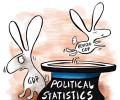
The Economic Survey 2022-23 (FY23), to be presented a day before Union Budget 2023-24 (FY24), is likely to project India's real gross domestic product (GDP) growth between 6 per cent and 7 per cent for FY24, Business Standard has learnt. The broader theme of the Survey could be on how India has dealt with two years of a global pandemic and the ongoing geopolitical disturbance, the strengths and weaknesses that emerged, and what lessons may be learnt. The much-awaited Survey will be the first one by Chief Economic Advisor V Anantha Nageswaran and his team in the finance ministry's economic division.
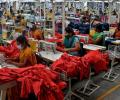
Enthused by higher than expected GDP numbers in the fourth quarter of 2022-23, Chief Economic Adviser (CEA) V Anantha Nageswaran on Wednesday said India's economic growth may exceed the initial estimate of 6.5 per cent in the current fiscal and the country can look for another year of solid economic performance.

'If you look at the order books of capital equipment companies or money deployed on the ground, there is forward movement in terms of actual investment by the private sector.'

Finance Minister Nirmala Sitharaman on Tuesday said the securities transaction tax (STT) will be increased on futures and options (F&O) trade from October 1 to discourage retail investors from investing in the risky instrument.

The pre-budget Economic Survey, which is tabled in Parliament ahead of the Union Budget to present the state of the economy and suggest policy prescriptions, quite often misses on the GDP forecast, sometimes by a significant margin. This time, Finance Minister Nirmala Sitharaman will table the Economic Survey for 2021-22 in the Lok Sabha on Monday soon after the President's address to both Houses of Parliament. She will present the Union Budget for the next financial year beginning April 1, 2022, on Tuesday.

The Union government could target a fiscal deficit of 5.8-6 per cent of nominal GDP for 2023-24, and it should continue its capital expenditure push and look to simplify the personal income tax regime, economists recommended Finance Minister Nirmala Sitharaman and her team during their pre-Budget interaction on Monday. Starting last week, Sitharaman had eight pre-Budget consultations this time. More than 110 invitees representing seven stakeholder groups participated in these meetings, the finance ministry said in a statement. The stakeholder groups included representatives and experts from agriculture and agro-processing industry; industry, infrastructure & climate change; financial sector and capital markets; services and trade; social sector; trade unions and labour organisations; and economists.

The gross tax revenues have touched 65 per cent of the Budget estimates at Rs 17.81 lakh crore during the first eight months of the current fiscal till November, propelled by corporate and personal income tax mop-up, according to the Economic Survey 2022-23 presented in Parliament on Tuesday. The survey, authored by Chief Economic Advisor V Anantha Nageswaran, said the 'substantial reforms' in India's taxation ecosystem post-2014 and policy reforms have removed the distortionary incentives from the economy. Reforms like GST, reduction in corporate taxes, exemption of sovereign wealth funds and pension funds from taxes, and removing Dividend Distribution tax have reduced the tax burden on individuals and businesses.

The Indian economy will grow at around 6.5 per cent in the current fiscal, notwithstanding high crude oil prices and increased uncertainty due climate changes, NITI Aayog member Arvind Virmani said on Thursday. Virmani also asserted that the gross household savings ratio in India has consistently gone up. In an interview with PTI, he said: "My growth projection (of India's GDP growth) is 6.5 per cent plus minus 0.5 per cent... because my experience is that the fluctuations in global GDP more or less has balanced out for us, assuming normal changes."
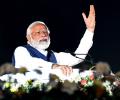
A book revolving around Prime Minister Narendra Modi's work and political and governance model with various chapters written by domain experts, his Cabinet colleagues and leading faces in different walks of life, is set to hit the bookstores next month.

Now that the economy is growing at a higher-than-expected rate, it is time to accelerate the pace of fiscal consolidation, and the Budget could be a good starting point, argues Rajesh Kumar.
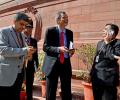
'We now look at divestment as an opportunity for maximising the value of public assets, not necessarily as a short-term resource-raising measure.'
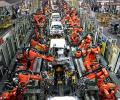
India's economy grew 6.1 per cent in the fourth quarter of 2022-23, pushing up the annual growth rate to 7.2 per cent, official data showed on Wednesday.
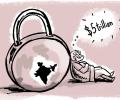
The wait for India to become a $5-trillion economic powerhouse by 2024-25 (FY25) is going to take longer than what the finance ministry had originally intended, according to the International Monetary Fund (IMF). The vision will instead be achieved in 2028-29 (FY29), reveals the IMF data, illustrating a four-year delay. Chief Economic Advisor (CEA) V Anantha Nageswaran had in February said India would become a $5-trillion economy by 2025-26 or the following year, on the back of 8-9 per cent sustained growth rate in real gross domestic product (GDP). However, the IMF data conveys that the economy will be $4.92 trillion in FY28, clearly alluding to the fact that the target will be realised in FY29.

India's inclusion in JP Morgan's bond index can channel billions of dollars into India. How will the government securities market handle it?
